 By Emma Ellis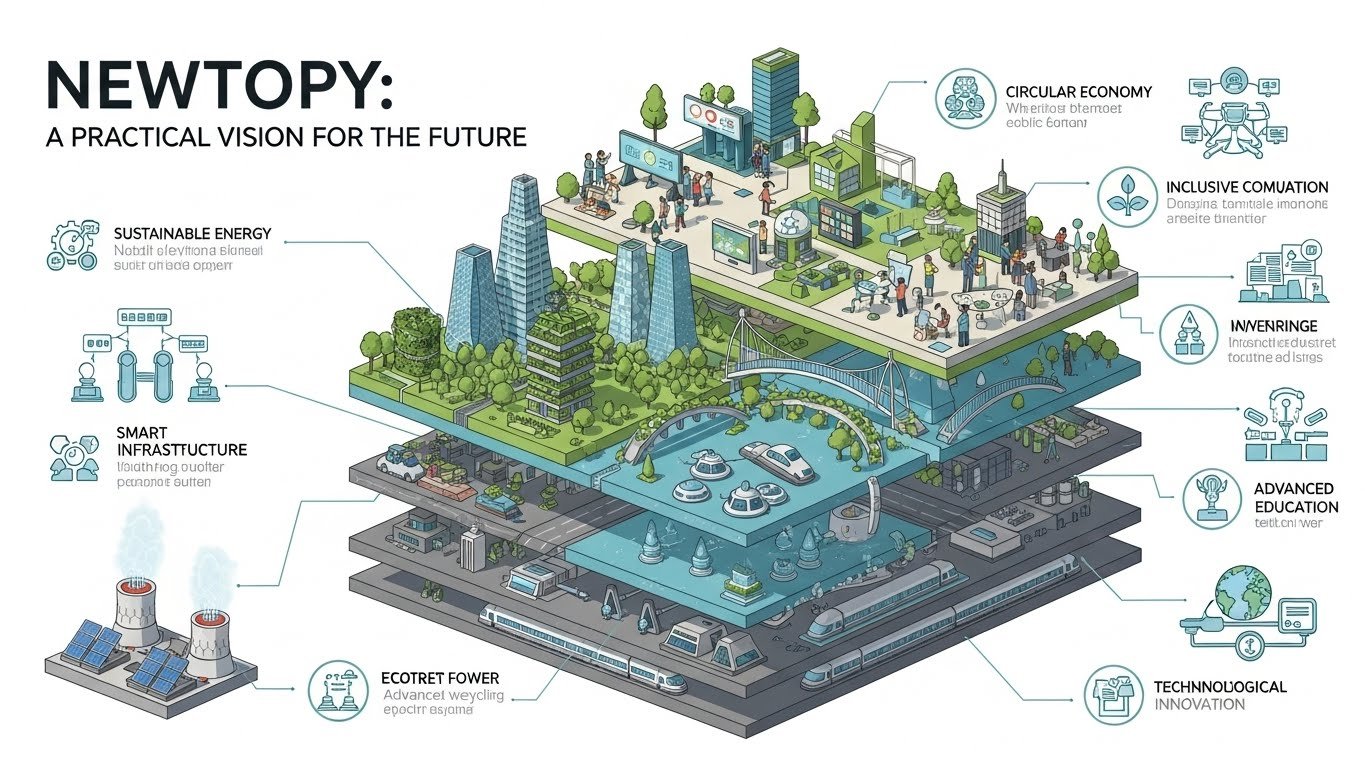
In a world facing rapid technological change, social transformation, and environmental challenges, traditional ideas of a perfect “utopia” often feel unrealistic or outdated. This is where Newtopy emerges as a fresh and meaningful concept. Rather than imagining an ideal world disconnected from reality, Newtopy focuses on practical, achievable solutions that improve everyday life. It represents a forward-thinking vision grounded in innovation, responsibility, and real-world progress.
Newtopy is not about chasing perfection. Instead, it embraces continuous improvement, adaptability, and collaboration to shape a future that works for people, communities, and the planet. As societies search for smarter ways to grow and evolve, Newtopy offers a balanced framework for building a better tomorrow—one step at a time.
Understanding the Concept of Newtopy
The term Newtopy appears to be a blend of “New” and “Utopia,” but its meaning goes far beyond wordplay. Unlike traditional utopian ideals that imagine flawless societies, Newtopy recognizes human limitations and real-world constraints. It focuses on what can realistically be achieved today and improved tomorrow.
At its core, Newtopy is about problem-solving. It encourages innovative thinking while remaining grounded in practicality. Whether applied to technology, urban development, sustainability, or social systems, the concept prioritizes functionality, inclusivity, and long-term value over unrealistic perfection.
Why Newtopy Matters in the Modern World
Modern societies face complex challenges such as climate change, economic inequality, digital overload, and rapid urbanization. Grand idealistic visions often fail because they overlook these realities. Newtopy matters because it:
-
Emphasizes action over imagination
-
Encourages incremental progress
-
Balances innovation with ethics
-
Focuses on human-centered solutions
By addressing problems with realistic tools and strategies, Newtopy becomes a framework that individuals, businesses, and governments can actually implement.
Newtopy and Technological Innovation
Technology plays a central role in shaping the future, and Newtopy aligns closely with responsible innovation. Instead of chasing trends for novelty, the Newtopy approach asks an important question: Does this technology genuinely improve lives?
From artificial intelligence to smart cities, Newtopy promotes technology that is:
-
Accessible and inclusive
-
Secure and transparent
-
Designed to solve real problems
This vision supports digital platforms that enhance productivity, education, healthcare, and communication without overwhelming users or sacrificing privacy.
A Human-Centered Approach to Progress
One of the defining features of Newtopy is its human-centered philosophy. Progress is not measured solely by economic growth or technological advancement, but by quality of life. This includes mental well-being, work-life balance, social connection, and equal opportunities.
Newtopy encourages systems that adapt to people, rather than forcing people to adapt to rigid systems. This mindset is especially relevant in modern workplaces, education models, and digital environments where flexibility and empathy are increasingly valued.
Newtopy in Urban Development and Living Spaces
Urban environments are rapidly expanding, creating challenges related to housing, transportation, and sustainability. Newtopy offers a practical approach to urban planning by combining smart design with social responsibility.
Instead of building futuristic cities that are costly and inaccessible, Newtopy supports:
-
Affordable housing solutions
-
Walkable and green neighborhoods
-
Efficient public transportation
-
Community-focused spaces
The goal is to create cities that are livable, inclusive, and environmentally conscious—cities that evolve with their residents.
Sustainability as a Core Principle
Sustainability is not an optional feature in Newtopy—it is a foundation. However, the Newtopy vision avoids extreme or impractical environmental ideals. Instead, it promotes achievable sustainability.
This includes:
-
Gradual transitions to renewable energy
-
Responsible consumption and production
-
Waste reduction through smart design
-
Encouraging eco-friendly habits at scale
By focusing on realistic environmental actions, Newtopy helps societies move toward sustainability without disruption or resistance.
Social Innovation and Community Impact
Newtopy recognizes that meaningful progress happens when communities are empowered. Social innovation within this framework emphasizes collaboration, inclusivity, and shared responsibility.
Rather than top-down solutions, Newtopy encourages:
-
Community-driven initiatives
-
Digital platforms that connect people
-
Education systems that teach problem-solving
-
Policies that adapt to diverse needs
This approach strengthens social bonds and ensures that progress benefits a wider population, not just a privileged few.
Economic Growth with Purpose
Traditional economic models often prioritize profit above all else. Newtopy challenges this mindset by promoting purpose-driven growth. Businesses and startups operating under this vision aim to create value not only for shareholders but also for society.
This includes:
-
Ethical entrepreneurship
-
Fair labor practices
-
Innovation aligned with social good
-
Long-term impact over short-term gains
Such an economic approach supports resilience and trust, both of which are essential for sustainable growth.
Digital Culture and the Newtopy Mindset
In the digital age, people are more connected than ever, yet often feel overwhelmed. Newtopy encourages a healthier digital culture by promoting mindful technology use.
This includes platforms and tools that:
-
Reduce unnecessary complexity
-
Support creativity and learning
-
Encourage meaningful interaction
-
Respect user time and attention
By rethinking digital experiences, Newtopy helps restore balance between online engagement and real-life connection.
Education and Learning for the Future
Education is a key pillar of any future-focused vision. Newtopy supports learning systems that prioritize adaptability, creativity, and real-world skills over rote memorization.
This includes:
-
Lifelong learning opportunities
-
Digital and hybrid education models
-
Emphasis on critical thinking
-
Practical skills for modern careers
Such an education system prepares individuals not just for jobs, but for continuous change and innovation.
Newtopy vs Traditional Utopian Ideas
Traditional utopias often fail because they aim for perfection in a flawed world. Newtopy succeeds because it accepts imperfection and works within it.
Key differences include:
-
Practical solutions vs ideal fantasies
-
Incremental improvement vs total transformation
-
Human-centered design vs rigid systems
This realistic approach makes Newtopy far more applicable to today’s complex global environment.
The Future Potential of Newtopy
As a concept, Newtopy is still evolving. Its strength lies in its flexibility and relevance across multiple fields. Whether applied to technology, society, business, or sustainability, it provides a guiding philosophy for progress that is both ambitious and achievable.
In the future, Newtopy could influence:
-
Policy-making and governance
-
Startup culture and innovation hubs
-
Digital platforms and ecosystems
-
Global sustainability initiatives
Its adaptability ensures that it remains relevant as challenges and opportunities change.
Conclusion: Building Tomorrow with Newtopy
Newtopy: A Practical Vision for the Future represents a shift in how we imagine progress. Instead of chasing unrealistic ideals, it encourages thoughtful action, ethical innovation, and human-centered solutions. By focusing on what works—and what can be improved—Newtopy offers a roadmap for sustainable and meaningful development.
In an era defined by uncertainty, Newtopy provides clarity. It reminds us that the future is not built overnight, nor is it built on perfection. It is built through practical choices, shared responsibility, and a commitment to making life better—step by step, for everyone.